It is darn well time that American college football fans start demanding the end of this ridiculous BCS system and start insisting on a college football playoff system for Division 1.
It is time to boycott the bowls.
When attendance and viewership drop off sharply, perhaps then the major college football programs will realize that American college football fans are sick and tired of the annual "BCS Mess".
The only good thing that is going to come out of this current Texas/Oklahoma travesty is that it will draw attention to how horrible the BCS is.
Texas and Oklahoma had identical records and Oklahoma lost to Texas on a neutral field. Texas also had a tougher schedule.
But now Oklahoma jumps over Texas when they both won their last game?
But the even more ridiculous result in this current college football season is this - there are 4 undefeated teams currently and THREE of them have absolutely ZERO chance of even getting into the national championship game.
How would you like to win all of your games and never have a chance to even play for the title?
How fair is that?
How long are we going to allow computers and polls to pick a champion?
Each year there is a BCS mess and each year it makes most of us increasingly sicker and more disgusted.
And how hard would it be to implement a playoff system?
An 8 team playoff would mean that 2 teams play one more game per year than they would normally, and 2 teams would play two extra games.
Other divisions in college football have a playoff system, so why not Division 1?
The truth is that it is time for the college football championship to be decided on the field and not in a computer.
So we need to start demanding a playoff system by using our boycott power.
If nobody watched the bowl games and nobody attended them then the powers that be would be forced into a change.
So perhaps it is time to send a message.
No more BCS!
We want a change.
Wednesday, December 3, 2008


Thursday, November 6, 2008
College Football Playoffs: I'll Say They're Worth $160 Million A Year
Yesterday, frustrated University of Georgia president Michael Adams proposed an eight-team playoff as a remedy to what he called a flawed BCS system.
It's obviously not the first time the playoff system has been mentioned. But the question I always get is, how much would a playoff system be worth to schools and conferences that participate in 2011, the first year something like this could happen?
Here's my official guess: The television money would double from today's dollars, with a network paying $640 million for a four-year playoff package.
Let me show you my math. Fox paid $320 million for the rights to air four out of the five BCS games through the 2010 season. That puts the value of each game at an average of $16 million. ABC paid $300 million for the rights to eight Rose Bowls and two BCS games through 2014. That values each game at $10 million.
If a playoff were to start in the 2011 season, the total eight-team package that could be offered would be three first-round games--the Fiesta, Orange and Sugar – and the rights to the winners of those games as well as the winner to the Rose Bowl (whose rights are held by ABC), which would represent the semifinals. Then of course, the National Championship game.
So that's a total of six games offered. The Fiesta, Orange and Sugar, I'll value at $22 million each. The semifinals, which adds the winner of the Rose, I'll value at $28 million each. And the national championship, I'll say is worth $38 million. I'll say it's likely that a four-year deal would be made so that it lines up with the end of ABC's relationship with the Rose Bowl.
$22 million times three = $66 million
$28 million times two = $56 million
$38 million times one = $38 million
That's $160 million.
Should ABC not win the rights, by the way, it would have to be compensated for the loss of what was sold to them as the National Championship game in 2014.
It's obviously not the first time the playoff system has been mentioned. But the question I always get is, how much would a playoff system be worth to schools and conferences that participate in 2011, the first year something like this could happen?
Here's my official guess: The television money would double from today's dollars, with a network paying $640 million for a four-year playoff package.
Let me show you my math. Fox paid $320 million for the rights to air four out of the five BCS games through the 2010 season. That puts the value of each game at an average of $16 million. ABC paid $300 million for the rights to eight Rose Bowls and two BCS games through 2014. That values each game at $10 million.
If a playoff were to start in the 2011 season, the total eight-team package that could be offered would be three first-round games--the Fiesta, Orange and Sugar – and the rights to the winners of those games as well as the winner to the Rose Bowl (whose rights are held by ABC), which would represent the semifinals. Then of course, the National Championship game.
So that's a total of six games offered. The Fiesta, Orange and Sugar, I'll value at $22 million each. The semifinals, which adds the winner of the Rose, I'll value at $28 million each. And the national championship, I'll say is worth $38 million. I'll say it's likely that a four-year deal would be made so that it lines up with the end of ABC's relationship with the Rose Bowl.
$22 million times three = $66 million
$28 million times two = $56 million
$38 million times one = $38 million
That's $160 million.
Should ABC not win the rights, by the way, it would have to be compensated for the loss of what was sold to them as the National Championship game in 2014.
Monday, November 3, 2008
Unfinished Issues: College Playoffs
The final night of the campaign brought the candidates to a lot of odd forums, none so odd as Monday Night Football, where Chris "Boomer" Berman proved that the Road to the White House goes through Bristol, home of the World Wide Leader in Sports.
So, he asked Barack Obama and John McCain, if they could change anything in sports what would it be?
McCain didn't repeat his vow last week that he wouldn't pre-empt the World Series with a political infomercial; instead he said he'd stop the spread of performance enhancing substances.
As for Obama he said, ""I think it is about time that we had playoffs in college football. I'm fed up with these computer rankings and this and that and the other. Get eight teams - the top eight teams right at the end. You got a playoff. Decide on a National Champion."
Yeah, even with a Democratic majority in Congress he won't be able to pull that off.
So, he asked Barack Obama and John McCain, if they could change anything in sports what would it be?
McCain didn't repeat his vow last week that he wouldn't pre-empt the World Series with a political infomercial; instead he said he'd stop the spread of performance enhancing substances.
As for Obama he said, ""I think it is about time that we had playoffs in college football. I'm fed up with these computer rankings and this and that and the other. Get eight teams - the top eight teams right at the end. You got a playoff. Decide on a National Champion."
Yeah, even with a Democratic majority in Congress he won't be able to pull that off.
Monday, October 13, 2008
The Wetzel plan
A playoff is coming to college football, not eventually but probably sooner than the moneyed-establishment wants to admit.
Big Ten commissioner Jim Delany, the Vladimir Putin of college sports and the key figure preventing a playoff, can stem the tide for only so long.
Unfortunately, we're stuck with the current Bowl Championship Series for the time being. But that doesn't mean we can't dream about what a real playoff would entail and the magic it would produce each December and January.
If you think you like Saturdays now, understand that this is just college football lite; one day to be looked back on as a quaint and confusing era.
Here's how the playoff will eventually work – and this isn't just my idea, it's essentially the exact scenario the NCAA (which will eventually run it) uses to run the football playoffs at the former Division I-AA, II and III.
We even made up a mock bracket for you to salivate over.
(Please note, whereas some conference title games still need to be played, for the sake of argument we assigned victory to the higher rated team in the current BCS standings to place and seed the field).

A 16-TEAM FIELD
Just like in what used to be Division I-AA, the tournament would feature four rounds with teams seeded one through 16. Just like the wildly popular and profitable NCAA men's basketball tournament, champions of all the conferences (all 11 of them) earn an automatic bid to the field.
Yes, all 11. Even the lousy conferences. While no one would argue that the winner of the Mid-American Conference is one of the top 16 teams in the country, there are multiple benefits of including champions of low-level leagues.
First is to maintain the integrity and relevancy of the regular season. While the idea that the season is a four-month playoff is both inaccurate and absurd, there should be a significant reward for an exceptional season.
The chance for an easier first-round opponent – in this case No. 1 Missouri would play No. 16 Central Michigan or Miami (Ohio) – is a big reward for a great regular season. Earning a top-three seeding would present a school a near breeze into the second round. Drop to a sixth-seed in this year's scenario and you are dealing with Florida.
On the flip side, it brings true Cinderella into the college football mix for the first time. Is it likely that Central Florida could beat Ohio State? Of course not, but as the men's basketball tournament has proven the mere possibility (or even a close game) draws in casual fans by the millions.
Last season the most memorable college football game was Boise State-Oklahoma, in part because Boise was the unbeaten underdog that wasn't supposed to win. When it did, in dramatic fashion, it became arguably the most popular team in America.
But it had no shot at a national title because the system says Boise can't be any good in 2007 because it wasn't any good in 1967. As illogical as this is, that's the system.
For even lower-rated conferences – the Sun Belts, the MACs – allowing annual access to the tournament would not only set off celebrations on small campuses but it would encourage investment in the sport at all levels. Suddenly, there would be a reason for teams in those leagues to really care. This would improve quality throughout the country.
With the bigger conferences, a championship would take on greater value. Does anyone without direct rooting interest really care if USC wins the Pac-10 Saturday? How about the Virginia Tech-Boston College ACC title game? You would now.
AT-LARGE BIDS
In addition to the 11 automatic bids, there would be five at-large selections made by a basketball-like selection committee. Most years, those would come from the power conferences (ACC, Big East, Big Ten, Big 12, Pac-10 and SEC).
While the selection process would still draw complaints from the teams left out, those schools often would have two or three losses or significant flaws. Gone forever would be the days of an unbeaten Auburn in the 2004 season not getting a chance at the title or the bizarre 2003 season where nearly everyone thought USC was the best team but got left out anyway.
HOME GAMES FOR HIGHER SEEDS IN FIRST THREE ROUNDS
The strangest part of the BCS is that outside businesses – the people who own the bowl games – get a cut of the revenue. It would be unfathomable for a league such as the NFL or NBA to allow independent promoters to stage its playoffs.
College football is leaving millions on the table by staging top games in far-off locales. Ohio State, for instance, earns an estimated $5 million-plus for each home game. And that is just direct revenue. Forbes estimates Buckeye football games generated $42 million for the Columbus area in 2005.
The 14 hugely profitable home games from the first three rounds would create a huge revenue stream.
There is simply no need to include the current bowl structure. Obviously no fan base can afford to travel week after week to neutral-site games. But they wouldn't have to. In what used to be Division I-AA, the playoffs are home field until the title game. That's the way it should be.
The competitive value of home-field advantage would also help maintain the importance of the regular season because the higher the seed, the more home games.
This would also be a boon to teams in the Midwest, which build their teams to deal with the predictably harsh weather only to play postseason games in generally warm, calm environs.
So how would say, USC fare if it didn't get a Big Ten opponent in Pasadena each January, but rather had to slip and slide around Ann Arbor or Columbus for a change? And who wouldn't want to see the Trojans invade one of those historic old stadiums, snow falling, and proving they have grit not just skill?
COMPETITION
That's the best part, of course, the games. As heart-thumping and pulse-stopping as college football is and always has been, we aren't even scratching the surface in our plan. We currently have nothing even close to this. Week after week of building excitement, tension and stakes.
A byproduct of the BCS has been a devaluing of competitiveness in college football. There is no longer an incentive to play games against other big-time opponents. It's not just intra-regional games that are all but gone but most non-conference games of any significance. Teams just load up on patsies to grab the home gate and maybe play one local rival.
Amazingly, the BCS rewards them for this.
Because of human voters' tendency to favor record over all else – unless the school is from outside the BCS – the goal of the season is simply not to lose. The easiest way to do that is to play as few teams as possible that are capable of beating you.
The BCS favors teams that load up on cupcakes early and play in a weaker BCS conference that ideally doesn't have to deal with a 13th game (for the league title).
Consider Kansas, which is rated No. 5 in the BCS (and was No. 2 last week) despite owning wins over opponents with a combined record of 45-63 record (.417 winning percentage). Maybe the Jayhawks are a great team that was capable of beating other great teams. But no one really knows. And the BCS didn't care.
The playoffs return the big-time games between teams from different conferences. Even better, it puts them on campus – not some far-flung NFL stadiums – in historic venues with all the pageantry.
Oklahoma-USC in the Coliseum in the first round? Florida-Ohio State in the Horseshoe in the second? How about the Buckeyes at West Virginia in a national semifinal? Every week of every year would be incredible.
BOWL GAMES COULD STILL EXIST
Understanding that there really isn't anything wrong with most bowl games – it's not like innocent people are dying because the Meineke Car Care Bowl exists – we'll allow them to stick around.
One bowl could serve as the championship game, giving college football its neutral, Super Bowl-style site to conclude the tournament.
As for all the other bowls, they can go on as they wish. The NIT still operates, doesn't it? It's not like most bowl games have any direct bearing on the championship now.
There is value to the smaller bowls in smaller communities. If the Sun Bowl in El Paso, Texas, still wishes to stage a game, it by all means should. It just won't have access to the 16 playoff teams. But it doesn't have access to teams of that quality now. It still can host a meaningless game between two moderately successful schools. For most bowls, nothing changes.
The lack of 16 "bowl-qualified" teams would filter down, of course, and run a couple of minor bowls out of business since there won't be enough bowl-eligible clubs. But if the reason college football is not staging a playoff is the need to save the International Bowl in Toronto, then the current system is more corrupt than we think.
THE SCHEDULE
While the former Division I-AA plays all four rounds in four weeks and stages the title game before Christmas, football’s top division might be better served playing the first one or two rounds in December, breaking for final exams and staging the semifinals just after Christmas and the title game in early January.
The schedule is a minimal concern. Something can be worked out. Whatever it is, it would allow teams and stars to become familiar to the American public, for momentum to build and excitement to grow.
The college football playoffs would have a chance to rival the NFL playoffs (Super Bowl included) as the biggest sporting event in the country. Fans would love it, players live for it and a game deserving of a real playoff finally enjoying it. It would capture the imagination of the nation.
Right now it's only a dream, but the day is coming. There is only so long the dictators can stop it.
Dan Wetzel is Yahoo! Sports' national columnist.
Big Ten commissioner Jim Delany, the Vladimir Putin of college sports and the key figure preventing a playoff, can stem the tide for only so long.
Unfortunately, we're stuck with the current Bowl Championship Series for the time being. But that doesn't mean we can't dream about what a real playoff would entail and the magic it would produce each December and January.
If you think you like Saturdays now, understand that this is just college football lite; one day to be looked back on as a quaint and confusing era.
Here's how the playoff will eventually work – and this isn't just my idea, it's essentially the exact scenario the NCAA (which will eventually run it) uses to run the football playoffs at the former Division I-AA, II and III.
We even made up a mock bracket for you to salivate over.
(Please note, whereas some conference title games still need to be played, for the sake of argument we assigned victory to the higher rated team in the current BCS standings to place and seed the field).
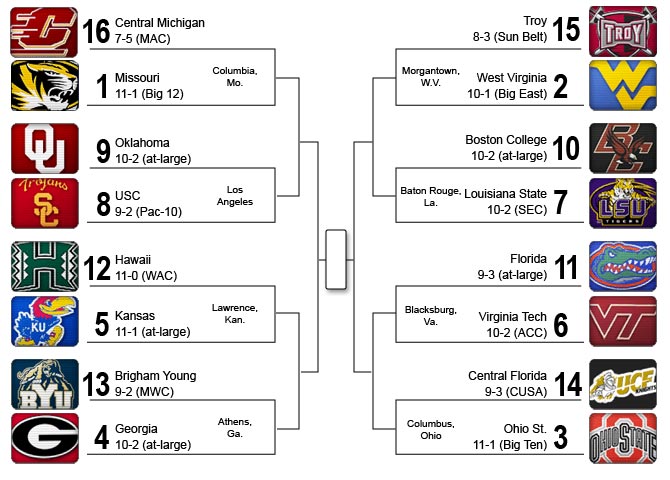
A 16-TEAM FIELD
Just like in what used to be Division I-AA, the tournament would feature four rounds with teams seeded one through 16. Just like the wildly popular and profitable NCAA men's basketball tournament, champions of all the conferences (all 11 of them) earn an automatic bid to the field.
Yes, all 11. Even the lousy conferences. While no one would argue that the winner of the Mid-American Conference is one of the top 16 teams in the country, there are multiple benefits of including champions of low-level leagues.
First is to maintain the integrity and relevancy of the regular season. While the idea that the season is a four-month playoff is both inaccurate and absurd, there should be a significant reward for an exceptional season.
The chance for an easier first-round opponent – in this case No. 1 Missouri would play No. 16 Central Michigan or Miami (Ohio) – is a big reward for a great regular season. Earning a top-three seeding would present a school a near breeze into the second round. Drop to a sixth-seed in this year's scenario and you are dealing with Florida.
On the flip side, it brings true Cinderella into the college football mix for the first time. Is it likely that Central Florida could beat Ohio State? Of course not, but as the men's basketball tournament has proven the mere possibility (or even a close game) draws in casual fans by the millions.
Last season the most memorable college football game was Boise State-Oklahoma, in part because Boise was the unbeaten underdog that wasn't supposed to win. When it did, in dramatic fashion, it became arguably the most popular team in America.
But it had no shot at a national title because the system says Boise can't be any good in 2007 because it wasn't any good in 1967. As illogical as this is, that's the system.
For even lower-rated conferences – the Sun Belts, the MACs – allowing annual access to the tournament would not only set off celebrations on small campuses but it would encourage investment in the sport at all levels. Suddenly, there would be a reason for teams in those leagues to really care. This would improve quality throughout the country.
With the bigger conferences, a championship would take on greater value. Does anyone without direct rooting interest really care if USC wins the Pac-10 Saturday? How about the Virginia Tech-Boston College ACC title game? You would now.
AT-LARGE BIDS
In addition to the 11 automatic bids, there would be five at-large selections made by a basketball-like selection committee. Most years, those would come from the power conferences (ACC, Big East, Big Ten, Big 12, Pac-10 and SEC).
While the selection process would still draw complaints from the teams left out, those schools often would have two or three losses or significant flaws. Gone forever would be the days of an unbeaten Auburn in the 2004 season not getting a chance at the title or the bizarre 2003 season where nearly everyone thought USC was the best team but got left out anyway.
HOME GAMES FOR HIGHER SEEDS IN FIRST THREE ROUNDS
The strangest part of the BCS is that outside businesses – the people who own the bowl games – get a cut of the revenue. It would be unfathomable for a league such as the NFL or NBA to allow independent promoters to stage its playoffs.
College football is leaving millions on the table by staging top games in far-off locales. Ohio State, for instance, earns an estimated $5 million-plus for each home game. And that is just direct revenue. Forbes estimates Buckeye football games generated $42 million for the Columbus area in 2005.
The 14 hugely profitable home games from the first three rounds would create a huge revenue stream.
There is simply no need to include the current bowl structure. Obviously no fan base can afford to travel week after week to neutral-site games. But they wouldn't have to. In what used to be Division I-AA, the playoffs are home field until the title game. That's the way it should be.
The competitive value of home-field advantage would also help maintain the importance of the regular season because the higher the seed, the more home games.
This would also be a boon to teams in the Midwest, which build their teams to deal with the predictably harsh weather only to play postseason games in generally warm, calm environs.
So how would say, USC fare if it didn't get a Big Ten opponent in Pasadena each January, but rather had to slip and slide around Ann Arbor or Columbus for a change? And who wouldn't want to see the Trojans invade one of those historic old stadiums, snow falling, and proving they have grit not just skill?
COMPETITION
That's the best part, of course, the games. As heart-thumping and pulse-stopping as college football is and always has been, we aren't even scratching the surface in our plan. We currently have nothing even close to this. Week after week of building excitement, tension and stakes.
A byproduct of the BCS has been a devaluing of competitiveness in college football. There is no longer an incentive to play games against other big-time opponents. It's not just intra-regional games that are all but gone but most non-conference games of any significance. Teams just load up on patsies to grab the home gate and maybe play one local rival.
Amazingly, the BCS rewards them for this.
Because of human voters' tendency to favor record over all else – unless the school is from outside the BCS – the goal of the season is simply not to lose. The easiest way to do that is to play as few teams as possible that are capable of beating you.
The BCS favors teams that load up on cupcakes early and play in a weaker BCS conference that ideally doesn't have to deal with a 13th game (for the league title).
Consider Kansas, which is rated No. 5 in the BCS (and was No. 2 last week) despite owning wins over opponents with a combined record of 45-63 record (.417 winning percentage). Maybe the Jayhawks are a great team that was capable of beating other great teams. But no one really knows. And the BCS didn't care.
The playoffs return the big-time games between teams from different conferences. Even better, it puts them on campus – not some far-flung NFL stadiums – in historic venues with all the pageantry.
Oklahoma-USC in the Coliseum in the first round? Florida-Ohio State in the Horseshoe in the second? How about the Buckeyes at West Virginia in a national semifinal? Every week of every year would be incredible.
BOWL GAMES COULD STILL EXIST
Understanding that there really isn't anything wrong with most bowl games – it's not like innocent people are dying because the Meineke Car Care Bowl exists – we'll allow them to stick around.
One bowl could serve as the championship game, giving college football its neutral, Super Bowl-style site to conclude the tournament.
As for all the other bowls, they can go on as they wish. The NIT still operates, doesn't it? It's not like most bowl games have any direct bearing on the championship now.
There is value to the smaller bowls in smaller communities. If the Sun Bowl in El Paso, Texas, still wishes to stage a game, it by all means should. It just won't have access to the 16 playoff teams. But it doesn't have access to teams of that quality now. It still can host a meaningless game between two moderately successful schools. For most bowls, nothing changes.
The lack of 16 "bowl-qualified" teams would filter down, of course, and run a couple of minor bowls out of business since there won't be enough bowl-eligible clubs. But if the reason college football is not staging a playoff is the need to save the International Bowl in Toronto, then the current system is more corrupt than we think.
THE SCHEDULE
While the former Division I-AA plays all four rounds in four weeks and stages the title game before Christmas, football’s top division might be better served playing the first one or two rounds in December, breaking for final exams and staging the semifinals just after Christmas and the title game in early January.
The schedule is a minimal concern. Something can be worked out. Whatever it is, it would allow teams and stars to become familiar to the American public, for momentum to build and excitement to grow.
The college football playoffs would have a chance to rival the NFL playoffs (Super Bowl included) as the biggest sporting event in the country. Fans would love it, players live for it and a game deserving of a real playoff finally enjoying it. It would capture the imagination of the nation.
Right now it's only a dream, but the day is coming. There is only so long the dictators can stop it.
Dan Wetzel is Yahoo! Sports' national columnist.
Which team would win a college football playoff?
This is supposed to be the most wonderful time of year, but what if it was just a little more wonderful for college football fans?
What if instead of waiting a month for Ohio State to play for the national championship against Florida, a team selected by voters and computers as better than Michigan, Boise State and other contenders, fans could watch a month of postseason college football games between teams playing each other for the right to reach the title tilt? In short, what if college football had a playoff system?
We can't make it happen in real life, but SportsCenter's holiday gift to you this year is the next best thing. All this week, as bowl season begins to heat up on ESPN and ESPN2, SportsCenter will play out a hypothetical 10-team playoff bracket for college football. Kirk Herbstreit and Mark May will set the field and weigh in each with their picks and analysis, but we also want to know how you think the bracket would play out, SportsNation.
The bracket below represents the official picks made by Herbstreit and May, as seen on SportsCenter each night. To sound off on how you think things would unfold, scroll to the bottom of the page and vote along with SportsNation.
SportsCenter's College Football Playoff!
Watch SportsCenter all week at 6 p.m. ET
Quarterfinals
Semifinals
Championship
National Champion
(8) Oklahoma
(1) Ohio State
(1) Ohio State
(4) LSU
(4) LSU
(3) Michigan
(4) LSU
(4) LSU
(5) USC
(3) Michigan
(6) Louisville
(3) Michigan
(2) Florida
(10) West Virginia
(2) Florida
What if instead of waiting a month for Ohio State to play for the national championship against Florida, a team selected by voters and computers as better than Michigan, Boise State and other contenders, fans could watch a month of postseason college football games between teams playing each other for the right to reach the title tilt? In short, what if college football had a playoff system?
We can't make it happen in real life, but SportsCenter's holiday gift to you this year is the next best thing. All this week, as bowl season begins to heat up on ESPN and ESPN2, SportsCenter will play out a hypothetical 10-team playoff bracket for college football. Kirk Herbstreit and Mark May will set the field and weigh in each with their picks and analysis, but we also want to know how you think the bracket would play out, SportsNation.
The bracket below represents the official picks made by Herbstreit and May, as seen on SportsCenter each night. To sound off on how you think things would unfold, scroll to the bottom of the page and vote along with SportsNation.
SportsCenter's College Football Playoff!
Watch SportsCenter all week at 6 p.m. ET
Quarterfinals
Semifinals
Championship
National Champion
(8) Oklahoma
(1) Ohio State
(1) Ohio State
(4) LSU
(4) LSU
(3) Michigan
(4) LSU
(4) LSU
(5) USC
(3) Michigan
(6) Louisville
(3) Michigan
(2) Florida
(10) West Virginia
(2) Florida
Monday, May 19, 2008
Possible Playoffs Continue to be a Major Topic
Tom Dienhart
Rivals.com College Football Senior Writer
DALLAS - Talk of a playoff won't go away, as conversation at the Football Forum showed last week.
This was the first Forum, sponsored by the National Football Foundation, College Hall of Fame and the Football Writers of America. It's hoped the Forum will become an annual event, a sort of think tank of discussion on some of the biggest issues facing the sport.
A panel -- which included coaches Mark Mangino of Kansas, Tyrone Willingham of Washington, Gary Patterson of TCU and Jim Tressel of Ohio State; athletic directors Kevin White of Notre Dame and Kevin Anderson of Army; and Florida State president T.K. Wetherell -- was against a playoff. But the subject of a playoff -- in whatever format -- stirred the passions of many. The current BCS format will remain until at least 2014, when the TV deal with the Rose Bowl, Pac-10 and Big Ten expires.
Despite that timetable, some panelists feel it is just delaying the inevitable: A playoff is coming.
"It's not a question of if there will be a playoff," Wetherell said, "but when there is a playoff."
Why?
"Money will drive it," says Wetherell.
As it stands, most schools have tapped out revenue streams such as seat licensing, stadium naming rights, club seats and suites. A playoff would provide additional money that will be needed in the future for a sport that, according to research White cited, features only six I-A schools that have a positive cash flow.
Even so, White said, "we need to maintain the meaningfulness of the bowls and regular season."
Rivals.com College Football Senior Writer
DALLAS - Talk of a playoff won't go away, as conversation at the Football Forum showed last week.
This was the first Forum, sponsored by the National Football Foundation, College Hall of Fame and the Football Writers of America. It's hoped the Forum will become an annual event, a sort of think tank of discussion on some of the biggest issues facing the sport.
A panel -- which included coaches Mark Mangino of Kansas, Tyrone Willingham of Washington, Gary Patterson of TCU and Jim Tressel of Ohio State; athletic directors Kevin White of Notre Dame and Kevin Anderson of Army; and Florida State president T.K. Wetherell -- was against a playoff. But the subject of a playoff -- in whatever format -- stirred the passions of many. The current BCS format will remain until at least 2014, when the TV deal with the Rose Bowl, Pac-10 and Big Ten expires.
Despite that timetable, some panelists feel it is just delaying the inevitable: A playoff is coming.
"It's not a question of if there will be a playoff," Wetherell said, "but when there is a playoff."
Why?
"Money will drive it," says Wetherell.
As it stands, most schools have tapped out revenue streams such as seat licensing, stadium naming rights, club seats and suites. A playoff would provide additional money that will be needed in the future for a sport that, according to research White cited, features only six I-A schools that have a positive cash flow.
Even so, White said, "we need to maintain the meaningfulness of the bowls and regular season."
Saturday, April 5, 2008
The People's Voice: College football playoffs
I expected the reaction for my column on a playoff for college football to be nuts, but I didn't expect how nuts. Nearly 3,000 emails have poured in and the column's been read by well over a million people.
The most amazing thing is that 95 percent of the emails were positive. Do you know how hard it is to get a million people to agree on anything? Radio hosts around the country have had me on to agree with me.
Which ought to tell the powers that be in college football – yes you, Jim Delany – that the public is dying for change.
Many of the letters I chose to run are critical, mainly because those are worth addressing and a bunch of notes saying, "great idea" wouldn't be particularly compelling.
But let me get a couple of things out of the way before we delve into an extremely detailed discussion – I wanted to keep the original column as clear and concise as possible. Here, we'll get serious.
The plan I have is both reasonable and doable (and will one day happen) because it is … reasonable and doable. Trust me, I've discussed this with scores of NCAA types through the years.
A lot of the proposals people float out are impossible. A 64-team tournament? A 128-team tournament? Shortening the regular season? Kicking some of the teams out of the top division? None of those would ever happen. I appreciate everyone's enthusiasm for change, but you have to give all parties something, as my proposal does.
For instance, why a 16-team playoff? Why not four? Why not byes for the top seeds? Because more games means more revenue – both in gate receipts and with television deals. College football doesn't want fewer playoff games, it wants more. That's why 16 teams can work. Understanding the NCAA, you have to include all conferences.
You have to give the business side something, the networks something, even the academic folks something – like a two-week break for finals so universities can continue to graduate 43 percent of the players.
This plan isn't perfect, but it is damn near close. And it is much better and more likely than anything else out there.
So, without further ado, on to the People's Voice …
Playoffs? You're talking about playoffs?
I am in absolute agreement with you … every word. But for me the issue is that nasty T-word, Tradition. Baseball "purists" run it out all the time in regards to the wild card, and even divisional play. It is the single most abused word in sports, and in particular NCAA football. Tradition. As you have pointed out, most teams have stopped loading their schedule with good teams. My question is how does Notre Dame figure into this?
Jeff Chew
Palamos, Spain
It's actually the P word – Power. The Big Ten and the Pac-10 don't want to give it up, even if there is more money involved. They run the show. But times will change.
As for Notre Dame (or any independent) they can get in as an at-large selection.
--------------------------------------------------------------------------------
While I appreciate your consistent harping on the Bowl Exhibition Series (call it what it is), you have to think smaller, at least at first. It's already a 12-game regular season now. Then there are the conference championship games.
A16-game field makes the college football season almost as long as the pro season. So, how about an eight-team tournament? Only conference champs get in.
Neil Tardy
Rochester, Minn.
I'm not blaming Neil for bringing this up, but this is one of the great water-muddying arguments that proponents use. Too many games? Suddenly, the establishment cares about the health of the players?
Just a couple of years ago they extended the season from 11 regular-season games to 12 for the sole purpose of making more money. That meant a net of an additional 120 games. A 16-team playoff is a net of just 15 games.
The real issue, however, isn't the number of games a player is exposed to, but the number of actual plays where bodies go in motion. Statistically, the more plays you are in, the more likely there is an injury.
Due to college football's rule to stop the clock after every first down, its overtime system and other quirks that prolong things, college games have more plays than NFL games. The college season may be shorter in games, but in total plays it is actually pretty close.
Last weekend there were 16 NFL games and 17 college games involving teams ranked in the AP top 25. On average, the pro games featured 127.3 plays from scrimmage. The college games averaged 147.9. That's 20.6 more plays, or an additional 16.2 percent.
A college team that competes in 14 games (12 regular season games, a conference title game and a bowl game) are exposed to the same number of plays as 16.3 NFL games, or a little more than a full NFL season.
In some extremes, it is even greater, especially when understanding that fatigue often leads to injury. The Tennessee-Kentucky quadruple overtime game featured a ridiculous 192 plays. To take it to the comparative extreme, Monday's Miami-Pittsburgh NFL game featured just 106 plays from scrimmage. So that's 81.1 percent more plays for the college guys, almost two games in one. Did you hear anyone crying about that?
In the interest of safety, the NCAA should adopt NFL clock rules to shorten the games. They did this partially for the 2006 season, but quickly reverted due to complaints from control freak coaches.
But by doing just that, a 17-game college season (the most possible under this playoff plan) would equal, in terms of plays from scrimmage, 14.6 current college games, a far more reasonable deal for college kids' knees.
Of course, guess who also likes all those extra breaks in the action? Television networks, naturally.
--------------------------------------------------------------------------------
It's funny how the toughest questions are dealt with the simplest solutions. Your plan works. Playoff system and bowl games.
Kevin Sidell
St. Petersburg, Fla.
The easiest way to stop a movement like this is to confuse the facts and argument so much that it seems impossible to solve. It isn't. In fact, it is simple. The NCAA already runs this system at its other levels.
Unfortunately, the smoke screen stuff has worked. Many people give up and claim it'll never happen because the argument is so convoluted with misinformation, faux arguments and broad-based blame at faceless "presidents." While it has been effective, little of it is true.
--------------------------------------------------------------------------------
I couldn't agree with you more. I heard a couple of commentators during the Michigan-Ohio State game briefly bring up the controversy of a college playoff system and they ended it by saying something along the lines of "with a season full of so many upsets and surprises we have a playoff system – it occurs each Saturday".
I was disgusted. I hope you will not waver or be intimidated. I hope others will join you. Terry Bowden seems to deeply favor a playoff system as well. Good luck and thanks for trying to make things more equitable and exciting for the fans as well.
William Rogers
Mobile, Ala.
Announcers work for two groups, the conference (in that case the Big Ten) which is staunchly in favor of the current bowl system. And ESPN, which broadcasts tons of bowl games and has contracts with the conferences and, in the most ridiculous of conflicts, even owns five bowl games (Las Vegas, Hawaii, Armed Forces, New Mexico and Papajohns.com).
It's not a real shock they'd spew the propaganda. Neither is it a shock that ESPN's myriad outlets won't tackle this issue – the one fans overwhelming care about the most – in any in-depth, significant or intelligent manner.
--------------------------------------------------------------------------------
I agree with you 100 percent, a playoff is the way to go. There is no way that teams like Hawaii or BYU or any other school from a small conference shouldn't be able to play for the right to be a National Champion. In the BCS if you're not a major powerhouse school you might as well not play at all.
Brian White
St Clair Shores, Mich.
The ridiculous thing is – as I mentioned in the column – it isn't about how good your team is in 2007, but how good it was back in 1957 or 1967 or 1977. Back then you could stockpile recruits with 150 scholarships and much of the west was still lightly populated.
These days with scholarship limits, the spread offense that eliminates the effectiveness of size and depth in the trenches and vast media exposure, it is asinine to hold to the old standards.
--------------------------------------------------------------------------------
I enjoyed your article on a college football playoff system. Why not make the bowl games part of the playoffs? Still have the Big Games – Rose, Sugar, etc. and make them part of the playoff system.
Rob West
Nashville, Tenn.
I think the question isn't why not, but why?
The bowl committees spend a lot of money promoting themselves. But including the bowls – other than for a Super Bowl-style title game – makes no sense, there are no advantages.
Why would the NCAA take the games out of facilities they own, share revenue with outside promoters and make fans and teams travel relentlessly to smaller venues so they can play in a stadium that most likely adds absolutely nothing to the experience?
In most cases, the games won't be sold out. The neutral-site ticket market is virtually impossible to pull off in sports, which is why it is rarely attempted. Very few bowl games are sellouts. Three years ago, USC and Oklahoma met for the BCS title in Fort Lauderdale, Fla. and there were plenty of empty seats. You can get a ticket to the men's basketball final for face value on the street most years.
Besides, other than the Rose Bowl, the BCS venues are quite forgettable – two of them are vapid, suburban NFL facilities. For the less prestigious bowls, it gets even worse. Meanwhile, college football boasts many of the most historic and breathtaking sporting environments in the country. Why not use them?
I commend the bowl folks for marketing themselves so well that it is ingrained in the minds of fans and the media that they are an essential part of this. But I've yet to hear a single sensible argument why that is actually true.
--------------------------------------------------------------------------------
I'd like to point out that maybe teams that lose in the first round or second round can still get invited to bowls. There is likely going to be some big schools that lose in those rounds and I am sure the Fiesta Bowl and Orange Bowl (etc.) would be happy to have these teams play in one of their bowls.
Michael Przybylowski
Toronto
I failed to make that clear enough in the original column. Depending on when you stage the tournament, as many as 12 playoff teams could be placed back into the bowl pool and make those games better. As far as I'm concerned, the bowls can do anything they want as long as they aren't interfering with a real playoff. They should be just like the NIT.
The bowls should serve college football; college football should not serve the bowls. I'm suspicious of those who argue otherwise.
--------------------------------------------------------------------------------
Your NCAA football playoff proposal is ridiculous. Four additional games is absurd. The great thing about college football, the thing that sets it apart from the boring NFL is that EVERY game is essentially a playoff game.
Yes, a school may lose a game and still qualify as the "champion" after the bowls have been played, and occasionally may even lose two. That hardly ever happens. For nearly a century the champion was determined like a beauty contest. This allowed for argument amongst fans as to who the real champion should be, but that was part of the charm.
Alex Ferguson
Portland, Ore.
First, the "every week is a playoff" argument is as tired as it is untruthful. Three weeks ago Ohio State lost one of those "every week is a playoff" games and yet could still back into the title game. Even LSU might still make it.
What playoff works like that? It's just not accurate no matter how many times it is repeated.
Does that mean that if there is a playoff, the Arkansas-LSU game would carry the same sense of urgency? No. I'll concede that. Although, there would still be some urgency due to the seeding and home games at stake that would significantly alter national title chances.
But conversely – and this is the part that is never discussed – so many additional games would take on "playoff" implications. This weekend's ACC title game, the UCLA-USC game, the Florida-Florida State game last Saturday, even the MAC title game (and so on and so on) would suddenly take on great importance. The number of games that would matter would increase, not decrease. The excitement of the regular season would be enhanced and expanded, not ruined.
Second, as for the oft-repeated comparison to the NFL season – where regular season games obviously matter less, this doesn't add up for three reasons.
First, rivalry games in college football can't be duplicated at the pro level. Alabama and Auburn played for nothing and everything last week.
Second, and more to the point, the NFL season is 16 games long, not 12. That alone devalues each game.
Third, the NFL invites 12 of its 32 teams to the playoffs, or 37.5 percent of the league. Division I-A has 120 teams. A 16-team college tournament would include just 13.3 percent of them and even that is a bit skewed since some are locked up by automatic bid (Florida can't win the Sun Belt).
The Flat Earth Folks of Delany argue this one relentlessly but unless we expanded the season to 16 games and held a 45-team tournament, then this isn't a logical comparison.
--------------------------------------------------------------------------------
As a D-I football official, I have been fortunate enough to officiate four games in the I-AA playoffs, including a national semifinal, and the excitement and urgency as each round progresses is awesome. I hope that in my officiating career (as also because I am a great fan) that the NCAA finally steps in and fixes the current mess. I enjoy your columns!
Randy Jackson
Demorest, Ga.
It's funny, I don't know anyone associated with the playoffs at the other divisions of college football who don't love it. And I don't know anyone in college football’s top division – at least anyone who isn't directly profiting off its system – that is remotely satisfied with what they have.
--------------------------------------------------------------------------------
What can college football fans do to show their support for a college football playoff? How can we make the bigwigs listen and see the benefits of such a playoff? Thanks and Gig'em
Tim Holder
Houston, Texas
There isn't much. You can harass your school's athletic director and conference commissioner. That can't hurt. And as I pointed out in January, the value of the Rose Bowl needs to be diminished for the Big Ten and Pac-10 to ever waver.
Considering the breadth and intensity of the movement for a playoff, if fans actually spread the word and organized, they could hurt the Rose Bowl immediately. I doubt that will happen, but that's the best advice I can offer.
--------------------------------------------------------------------------------
I like your plan! However, I think this alternative better embraces the tradition of college football. Check it out:
1. We say all Big Ten teams with winning records get auto-bids to a 12-team bracket.
2. We play all games at rotating Big Ten venues.
3. Big Ten schools get 50 percent of all TV revenue and 100 percent of ticket sales.
4. The commissioner of the Big Ten gets a 10 percent cut of any revenue that would have gone to a non-Big Ten school under the old system.
5. The SEC can secede from the NCAA, play its regular season and championship game.
6. The SEC winner can then challenge the winner of the NCAA/Big Ten bracket to a home-and-home series that will not get played because the Big Ten winner will complain that it's too hot in September below the Ohio River.
7. Then we fire on Fort Sumter.
Casey Dalton
Good to see Vladimir Delany checking in from Moscow.
Dan Wetzel is Yahoo! Sports' national columnist.
The most amazing thing is that 95 percent of the emails were positive. Do you know how hard it is to get a million people to agree on anything? Radio hosts around the country have had me on to agree with me.
Which ought to tell the powers that be in college football – yes you, Jim Delany – that the public is dying for change.
Many of the letters I chose to run are critical, mainly because those are worth addressing and a bunch of notes saying, "great idea" wouldn't be particularly compelling.
But let me get a couple of things out of the way before we delve into an extremely detailed discussion – I wanted to keep the original column as clear and concise as possible. Here, we'll get serious.
The plan I have is both reasonable and doable (and will one day happen) because it is … reasonable and doable. Trust me, I've discussed this with scores of NCAA types through the years.
A lot of the proposals people float out are impossible. A 64-team tournament? A 128-team tournament? Shortening the regular season? Kicking some of the teams out of the top division? None of those would ever happen. I appreciate everyone's enthusiasm for change, but you have to give all parties something, as my proposal does.
For instance, why a 16-team playoff? Why not four? Why not byes for the top seeds? Because more games means more revenue – both in gate receipts and with television deals. College football doesn't want fewer playoff games, it wants more. That's why 16 teams can work. Understanding the NCAA, you have to include all conferences.
You have to give the business side something, the networks something, even the academic folks something – like a two-week break for finals so universities can continue to graduate 43 percent of the players.
This plan isn't perfect, but it is damn near close. And it is much better and more likely than anything else out there.
So, without further ado, on to the People's Voice …
Playoffs? You're talking about playoffs?
I am in absolute agreement with you … every word. But for me the issue is that nasty T-word, Tradition. Baseball "purists" run it out all the time in regards to the wild card, and even divisional play. It is the single most abused word in sports, and in particular NCAA football. Tradition. As you have pointed out, most teams have stopped loading their schedule with good teams. My question is how does Notre Dame figure into this?
Jeff Chew
Palamos, Spain
It's actually the P word – Power. The Big Ten and the Pac-10 don't want to give it up, even if there is more money involved. They run the show. But times will change.
As for Notre Dame (or any independent) they can get in as an at-large selection.
--------------------------------------------------------------------------------
While I appreciate your consistent harping on the Bowl Exhibition Series (call it what it is), you have to think smaller, at least at first. It's already a 12-game regular season now. Then there are the conference championship games.
A16-game field makes the college football season almost as long as the pro season. So, how about an eight-team tournament? Only conference champs get in.
Neil Tardy
Rochester, Minn.
I'm not blaming Neil for bringing this up, but this is one of the great water-muddying arguments that proponents use. Too many games? Suddenly, the establishment cares about the health of the players?
Just a couple of years ago they extended the season from 11 regular-season games to 12 for the sole purpose of making more money. That meant a net of an additional 120 games. A 16-team playoff is a net of just 15 games.
The real issue, however, isn't the number of games a player is exposed to, but the number of actual plays where bodies go in motion. Statistically, the more plays you are in, the more likely there is an injury.
Due to college football's rule to stop the clock after every first down, its overtime system and other quirks that prolong things, college games have more plays than NFL games. The college season may be shorter in games, but in total plays it is actually pretty close.
Last weekend there were 16 NFL games and 17 college games involving teams ranked in the AP top 25. On average, the pro games featured 127.3 plays from scrimmage. The college games averaged 147.9. That's 20.6 more plays, or an additional 16.2 percent.
A college team that competes in 14 games (12 regular season games, a conference title game and a bowl game) are exposed to the same number of plays as 16.3 NFL games, or a little more than a full NFL season.
In some extremes, it is even greater, especially when understanding that fatigue often leads to injury. The Tennessee-Kentucky quadruple overtime game featured a ridiculous 192 plays. To take it to the comparative extreme, Monday's Miami-Pittsburgh NFL game featured just 106 plays from scrimmage. So that's 81.1 percent more plays for the college guys, almost two games in one. Did you hear anyone crying about that?
In the interest of safety, the NCAA should adopt NFL clock rules to shorten the games. They did this partially for the 2006 season, but quickly reverted due to complaints from control freak coaches.
But by doing just that, a 17-game college season (the most possible under this playoff plan) would equal, in terms of plays from scrimmage, 14.6 current college games, a far more reasonable deal for college kids' knees.
Of course, guess who also likes all those extra breaks in the action? Television networks, naturally.
--------------------------------------------------------------------------------
It's funny how the toughest questions are dealt with the simplest solutions. Your plan works. Playoff system and bowl games.
Kevin Sidell
St. Petersburg, Fla.
The easiest way to stop a movement like this is to confuse the facts and argument so much that it seems impossible to solve. It isn't. In fact, it is simple. The NCAA already runs this system at its other levels.
Unfortunately, the smoke screen stuff has worked. Many people give up and claim it'll never happen because the argument is so convoluted with misinformation, faux arguments and broad-based blame at faceless "presidents." While it has been effective, little of it is true.
--------------------------------------------------------------------------------
I couldn't agree with you more. I heard a couple of commentators during the Michigan-Ohio State game briefly bring up the controversy of a college playoff system and they ended it by saying something along the lines of "with a season full of so many upsets and surprises we have a playoff system – it occurs each Saturday".
I was disgusted. I hope you will not waver or be intimidated. I hope others will join you. Terry Bowden seems to deeply favor a playoff system as well. Good luck and thanks for trying to make things more equitable and exciting for the fans as well.
William Rogers
Mobile, Ala.
Announcers work for two groups, the conference (in that case the Big Ten) which is staunchly in favor of the current bowl system. And ESPN, which broadcasts tons of bowl games and has contracts with the conferences and, in the most ridiculous of conflicts, even owns five bowl games (Las Vegas, Hawaii, Armed Forces, New Mexico and Papajohns.com).
It's not a real shock they'd spew the propaganda. Neither is it a shock that ESPN's myriad outlets won't tackle this issue – the one fans overwhelming care about the most – in any in-depth, significant or intelligent manner.
--------------------------------------------------------------------------------
I agree with you 100 percent, a playoff is the way to go. There is no way that teams like Hawaii or BYU or any other school from a small conference shouldn't be able to play for the right to be a National Champion. In the BCS if you're not a major powerhouse school you might as well not play at all.
Brian White
St Clair Shores, Mich.
The ridiculous thing is – as I mentioned in the column – it isn't about how good your team is in 2007, but how good it was back in 1957 or 1967 or 1977. Back then you could stockpile recruits with 150 scholarships and much of the west was still lightly populated.
These days with scholarship limits, the spread offense that eliminates the effectiveness of size and depth in the trenches and vast media exposure, it is asinine to hold to the old standards.
--------------------------------------------------------------------------------
I enjoyed your article on a college football playoff system. Why not make the bowl games part of the playoffs? Still have the Big Games – Rose, Sugar, etc. and make them part of the playoff system.
Rob West
Nashville, Tenn.
I think the question isn't why not, but why?
The bowl committees spend a lot of money promoting themselves. But including the bowls – other than for a Super Bowl-style title game – makes no sense, there are no advantages.
Why would the NCAA take the games out of facilities they own, share revenue with outside promoters and make fans and teams travel relentlessly to smaller venues so they can play in a stadium that most likely adds absolutely nothing to the experience?
In most cases, the games won't be sold out. The neutral-site ticket market is virtually impossible to pull off in sports, which is why it is rarely attempted. Very few bowl games are sellouts. Three years ago, USC and Oklahoma met for the BCS title in Fort Lauderdale, Fla. and there were plenty of empty seats. You can get a ticket to the men's basketball final for face value on the street most years.
Besides, other than the Rose Bowl, the BCS venues are quite forgettable – two of them are vapid, suburban NFL facilities. For the less prestigious bowls, it gets even worse. Meanwhile, college football boasts many of the most historic and breathtaking sporting environments in the country. Why not use them?
I commend the bowl folks for marketing themselves so well that it is ingrained in the minds of fans and the media that they are an essential part of this. But I've yet to hear a single sensible argument why that is actually true.
--------------------------------------------------------------------------------
I'd like to point out that maybe teams that lose in the first round or second round can still get invited to bowls. There is likely going to be some big schools that lose in those rounds and I am sure the Fiesta Bowl and Orange Bowl (etc.) would be happy to have these teams play in one of their bowls.
Michael Przybylowski
Toronto
I failed to make that clear enough in the original column. Depending on when you stage the tournament, as many as 12 playoff teams could be placed back into the bowl pool and make those games better. As far as I'm concerned, the bowls can do anything they want as long as they aren't interfering with a real playoff. They should be just like the NIT.
The bowls should serve college football; college football should not serve the bowls. I'm suspicious of those who argue otherwise.
--------------------------------------------------------------------------------
Your NCAA football playoff proposal is ridiculous. Four additional games is absurd. The great thing about college football, the thing that sets it apart from the boring NFL is that EVERY game is essentially a playoff game.
Yes, a school may lose a game and still qualify as the "champion" after the bowls have been played, and occasionally may even lose two. That hardly ever happens. For nearly a century the champion was determined like a beauty contest. This allowed for argument amongst fans as to who the real champion should be, but that was part of the charm.
Alex Ferguson
Portland, Ore.
First, the "every week is a playoff" argument is as tired as it is untruthful. Three weeks ago Ohio State lost one of those "every week is a playoff" games and yet could still back into the title game. Even LSU might still make it.
What playoff works like that? It's just not accurate no matter how many times it is repeated.
Does that mean that if there is a playoff, the Arkansas-LSU game would carry the same sense of urgency? No. I'll concede that. Although, there would still be some urgency due to the seeding and home games at stake that would significantly alter national title chances.
But conversely – and this is the part that is never discussed – so many additional games would take on "playoff" implications. This weekend's ACC title game, the UCLA-USC game, the Florida-Florida State game last Saturday, even the MAC title game (and so on and so on) would suddenly take on great importance. The number of games that would matter would increase, not decrease. The excitement of the regular season would be enhanced and expanded, not ruined.
Second, as for the oft-repeated comparison to the NFL season – where regular season games obviously matter less, this doesn't add up for three reasons.
First, rivalry games in college football can't be duplicated at the pro level. Alabama and Auburn played for nothing and everything last week.
Second, and more to the point, the NFL season is 16 games long, not 12. That alone devalues each game.
Third, the NFL invites 12 of its 32 teams to the playoffs, or 37.5 percent of the league. Division I-A has 120 teams. A 16-team college tournament would include just 13.3 percent of them and even that is a bit skewed since some are locked up by automatic bid (Florida can't win the Sun Belt).
The Flat Earth Folks of Delany argue this one relentlessly but unless we expanded the season to 16 games and held a 45-team tournament, then this isn't a logical comparison.
--------------------------------------------------------------------------------
As a D-I football official, I have been fortunate enough to officiate four games in the I-AA playoffs, including a national semifinal, and the excitement and urgency as each round progresses is awesome. I hope that in my officiating career (as also because I am a great fan) that the NCAA finally steps in and fixes the current mess. I enjoy your columns!
Randy Jackson
Demorest, Ga.
It's funny, I don't know anyone associated with the playoffs at the other divisions of college football who don't love it. And I don't know anyone in college football’s top division – at least anyone who isn't directly profiting off its system – that is remotely satisfied with what they have.
--------------------------------------------------------------------------------
What can college football fans do to show their support for a college football playoff? How can we make the bigwigs listen and see the benefits of such a playoff? Thanks and Gig'em
Tim Holder
Houston, Texas
There isn't much. You can harass your school's athletic director and conference commissioner. That can't hurt. And as I pointed out in January, the value of the Rose Bowl needs to be diminished for the Big Ten and Pac-10 to ever waver.
Considering the breadth and intensity of the movement for a playoff, if fans actually spread the word and organized, they could hurt the Rose Bowl immediately. I doubt that will happen, but that's the best advice I can offer.
--------------------------------------------------------------------------------
I like your plan! However, I think this alternative better embraces the tradition of college football. Check it out:
1. We say all Big Ten teams with winning records get auto-bids to a 12-team bracket.
2. We play all games at rotating Big Ten venues.
3. Big Ten schools get 50 percent of all TV revenue and 100 percent of ticket sales.
4. The commissioner of the Big Ten gets a 10 percent cut of any revenue that would have gone to a non-Big Ten school under the old system.
5. The SEC can secede from the NCAA, play its regular season and championship game.
6. The SEC winner can then challenge the winner of the NCAA/Big Ten bracket to a home-and-home series that will not get played because the Big Ten winner will complain that it's too hot in September below the Ohio River.
7. Then we fire on Fort Sumter.
Casey Dalton
Good to see Vladimir Delany checking in from Moscow.
Dan Wetzel is Yahoo! Sports' national columnist.
There Can't Be a IA College Football Playoff
So, you think there can't be a IA college football playoff for one reason or another?
Let's begin with the following:
1. Many people state that a playoff would take years to implement, but that is only an excuse. To illustrate this point, do you know when the BcS was created (concocted)? June/July of 1998, and the season started a short month later, the point is that next-day service does happen regularly. In fact, BcS trademarks were not even submitted until October 1998, during the season. And guess who owns these BcS trademarks? Bowl Alliance Properties in Birmingham, Alabama.
2. The existing BcS contract is a NON-ISSUE! There are several rational explanations as to why and how any contract can be replaced, but what if they signed the BcS contract through 3006. Could we then not have a playoff for another thousand years. Of course that would be ludicrous, and so is any talk of the BcS contract getting in the way.
3. Proceeds will go back to the heart of the great sport of college football, the student-athletes and the fans. The applicable and flawless systems are now available and have been available to the NCAA and other relevant parties.
4. What can the NCAA do in regard to a IA playoff? The NCAA has the authority to oversee every facet of the bowl process and postseason except provide the playoff system and negotiate contracts.
5. The Sport Lawyers Journal states that the BcS would in all likelihood be found to violate the Sherman Act (Antitrust and Anti-competitiveness implications) at a minimum due to a less restrictive alternative doctrine. This means that if an outside challenger could show that a National Championship could be produced in a manner that would cause much less injury to the market (such as the lesser IA conferences), then the BcS would be displayed as an illegal arrangement. The point is that if we, were to pursue litigation, we could throw the current BcS administrators out on the street, but in that scenario, lawyers would win as opposed to the fans and student-athletes.
Let's begin with the following:
1. Many people state that a playoff would take years to implement, but that is only an excuse. To illustrate this point, do you know when the BcS was created (concocted)? June/July of 1998, and the season started a short month later, the point is that next-day service does happen regularly. In fact, BcS trademarks were not even submitted until October 1998, during the season. And guess who owns these BcS trademarks? Bowl Alliance Properties in Birmingham, Alabama.
2. The existing BcS contract is a NON-ISSUE! There are several rational explanations as to why and how any contract can be replaced, but what if they signed the BcS contract through 3006. Could we then not have a playoff for another thousand years. Of course that would be ludicrous, and so is any talk of the BcS contract getting in the way.
3. Proceeds will go back to the heart of the great sport of college football, the student-athletes and the fans. The applicable and flawless systems are now available and have been available to the NCAA and other relevant parties.
4. What can the NCAA do in regard to a IA playoff? The NCAA has the authority to oversee every facet of the bowl process and postseason except provide the playoff system and negotiate contracts.
5. The Sport Lawyers Journal states that the BcS would in all likelihood be found to violate the Sherman Act (Antitrust and Anti-competitiveness implications) at a minimum due to a less restrictive alternative doctrine. This means that if an outside challenger could show that a National Championship could be produced in a manner that would cause much less injury to the market (such as the lesser IA conferences), then the BcS would be displayed as an illegal arrangement. The point is that if we, were to pursue litigation, we could throw the current BcS administrators out on the street, but in that scenario, lawyers would win as opposed to the fans and student-athletes.
Wednesday, January 2, 2008
College Football Playoffs: Sooners are undisputed national champs
In what was expected to be a high-powered game between two great offenses, Oklahoma played great defense and got a 44-yard field goal from Garrett Hartley with 13 seconds remaining to lift the Sooners over USC 16-13 in the CBSSports.com College Football Playoffs.
Down 13-10, the Trojans tied the game on a 50-yard field goal by David Buehler with less than two minutes remaining, but the Sooners turned to an unlikely hero to guide the team down for the game-winning kick.
Oklahoma is the 2007 national champion ... if we had a playoff system. (Getty Images)
Joey Halzle, who was forced to come off the bench after Sam Bradford was injured in the second quarter, came up with two big plays to get the team into field goal range.
Halzle hit Maclom Kelly on a 12-yard pass to keep the drive alive and then on third-and-7, Halzle scrambled 25 yards down to the USC 34. He hit Kelly on another short pass to set up the kick.
Halzle finished the game 17-of-25 for 191 yards and a touchdown, while Bradford was 9-of-13 for 104 yards. Allen Patrick had 67 yards rushing, while DeMarco Murray added 49 yards on the ground.
USC’s John David Booty struggled against the Oklahoma defense, throwing for just 220 yards with zero touchdowns and an interception. Fred Davis led the way with three catches for 51 yards. Linebacker Keith Rivers had nine tackles, four for a loss, a sack and an interception.
Now, of course, this is all make-believe, but this is what it would have been like to have a 16-team playoff.
At the end of the season, no questions asked.
Under this scenario -- Oklahoma would have beaten BYU, Florida, No. 1 Ohio State and USC.
A true national champion, which was decided on the field. Not based on the opinions of sports writers and computer rankings.
We might end up with a great national championship game between LSU and Ohio State next Monday, but that’s not the point. Because under the current system, we don’t know who the two best teams are. Maybe it’s USC, Oklahoma or Georgia, but we’ll never know because of the BCS and its idiotic way of determining a "fake" national champion.
Congrats Oklahoma, you proved it in our bracket. You are our national champion.
Down 13-10, the Trojans tied the game on a 50-yard field goal by David Buehler with less than two minutes remaining, but the Sooners turned to an unlikely hero to guide the team down for the game-winning kick.
Oklahoma is the 2007 national champion ... if we had a playoff system. (Getty Images)
Joey Halzle, who was forced to come off the bench after Sam Bradford was injured in the second quarter, came up with two big plays to get the team into field goal range.
Halzle hit Maclom Kelly on a 12-yard pass to keep the drive alive and then on third-and-7, Halzle scrambled 25 yards down to the USC 34. He hit Kelly on another short pass to set up the kick.
Halzle finished the game 17-of-25 for 191 yards and a touchdown, while Bradford was 9-of-13 for 104 yards. Allen Patrick had 67 yards rushing, while DeMarco Murray added 49 yards on the ground.
USC’s John David Booty struggled against the Oklahoma defense, throwing for just 220 yards with zero touchdowns and an interception. Fred Davis led the way with three catches for 51 yards. Linebacker Keith Rivers had nine tackles, four for a loss, a sack and an interception.
Now, of course, this is all make-believe, but this is what it would have been like to have a 16-team playoff.
At the end of the season, no questions asked.
Under this scenario -- Oklahoma would have beaten BYU, Florida, No. 1 Ohio State and USC.
A true national champion, which was decided on the field. Not based on the opinions of sports writers and computer rankings.
We might end up with a great national championship game between LSU and Ohio State next Monday, but that’s not the point. Because under the current system, we don’t know who the two best teams are. Maybe it’s USC, Oklahoma or Georgia, but we’ll never know because of the BCS and its idiotic way of determining a "fake" national champion.
Congrats Oklahoma, you proved it in our bracket. You are our national champion.
Subscribe to:
Posts (Atom)

 Posts
Posts

